
No responses yet-- so check it out:
Photo: I'm not including a photo. I'm sure this will cost me some points, but I hope I can make them up elsewhere on the form. It's sort of a bold move, don't you think? Kinda makes a statement about the impermanence of the flesh and the temporary nature of our physical existence. Besides, I never seem to show up in photos... or in mirrors. Hmm.
Age: 34-ish. (When we finally tracked down my mom, she couldn't remember the exact year she left me at the YMCA) Disposition: Intensely laid back, which sometimes manifests in a fiery, uncompromising Savonarola-like fury. But hey, whatever.
Ideal Mate: Someone just like me, except sorta foreign-looking.
Hobbies: Long walks in the forest with my trusty band of society's offscouring, robbing from the rich to give to the poor. I can take apart and reassemble a zither in under 8 minutes. I also collect stamps. And I'm a member of the Pheidippides Heritage Society, whose members run marathons hoping to die at the finish line.
Religion: Episcopalian. Wait-- scratch that. High Church Episcopal. But actually there's a strong vein of Calvinism that I picked up during my summer missions project with the farming family in Iowa. In fact, intertwined with the Calvinism (which is coming back-- see Time Magazine's March issue) is an equally intense dedication to social justice. But, hey, certainly not Liberation Theology. Ha, of course, if that were true I wouldn't tell YOU! Anyway, see the attached pdf with my thesis-length theological musings, or read my latest blog posting at www.skippy'sjesus.com. (Do not feel pressured to visit my online store for t-shirts or coffee mugs)
Education: Four years at University of Texas at Elm Mott. (One semester as cheerleader for the Fightin' Fire Ants! Yay!) Still working on my last remedial basketweaving course-- after that they'll send me my diploma, I think.
Employment: Poet-in-residence at our local public library. This is currently not a paid position, but there are a lot of perks. Access to the bathroom is a big perk. And the research information librarian will answer most any question I have. Really, it's a pretty sweet deal. The intern pays me 5 cents a book to help him reshelve while he curls up in the corner for some Second Life on his iPod Touch. That keeps me in Mountain Dew.
Turn Ons: Naked women usually do the trick, although as I get older, I sometimes need to slam down an extra Mountain Dew.
Tuesday, March 17, 2009
Too bad I'm not available....

Tuesday, October 28, 2008
Next, the 'Soylent Green' Bible
The Green Bible has sprouted on the religious publishing scene, and has even received a stamp of approval from the Sierra Club. The new version, which costs $29.95, "will equip and encourage you to see God's vision for creation and help you engage in the work of healing and sustaining it."
This New Revised Standard Version published by HarperCollins highlights environmentally significant passages in green, is printed with soy ink on water-coated recyclable paper and bound in a cloth-and-linen cover.
The only drawback is that the book is not totally edible. If Tony Campolo, Jim Wallis and the Sojourners crowd are "Red Letter" Christians, then who are "Green Letter" Christians? Well, Brian McLaren explains "Why I Am Green." And Matthew Sleeth, N. T. Wright and Desmond Tutu contribute, along with Earth-conscious essays and poems from Wendell Beery, St. Francis of Assisi and Pope John Paul II.
Why do we need a Green Bible? Because "with over 1,000 references to the earth in the Bible, compared to 490 references to heaven and 530 references to love, the Bible carries a powerful message for the earth."
On the other hand, out of the 773,692 total words in the Bible, "and" is used almost 70,000 times. Forgive my quibbling, but the scriptures carry a powerful message for conjunctions, too.
In one essay by J. Matthew Sleeth, a good point is made that the Bible starts with a tree in Genesis and ends with one in Revelation. That's cool. I like that. I also understand most of the green-highlighted passages I read in the online sample-- they call it the "Green Bible Trail." Sort of like W. A. Criswell's "Scarlet Thread through the Bible" except about landscaping instead of salvation.
But I'm confused about why some passages were left out.
For instance, in the sample given from the book of Ruth, nothing was highlighted in green at all. In the story about Ruth gleaning in Boaz's field, it says he "heaped up for her some parched grain. She ate until she was satisfied, and she had some left over. " Why isn't that in green? Is it because people are messing with nature here, taking dominion over it, using it to feed themselves?
Just askin'.
Don't get me wrong, I certainly don't want us to all have to scramble for survival on a planet blighted with toxic waste, choking on pollution and divorced from nature by our technology. (Oh yeah, never mind, that's already happening). But don't cheat me by rationing my green-highlighted Bible passages!
Environmental checklists can get ridiculous. At the bottom of the screen on the publisher's web site, I noticed it proudly proclaims: "This site was made without using paper."
A website without paper!
I wish that would catch on, because I'm tired of getting ink all over my hands when I click through the New York Times headlines links. Thanks, HarperCollins.
• Furl • StumbleUpon • Technorati Tags: Green Bible, Christian humor, satire, humor
Wednesday, August 20, 2008
The Olympics, and achievement just out of reach
Before our morning Bible study some of us walk up to the local coffee shop, bypassing Starbucks. We're friends with the owners and the staff and we've been walking up there almost every day for a decade.
When Bill opens the place, he takes some time to banter with us, mostly making fun of our friend Gary. With nonstop Olympics coverage this week, Gary's been regaling us with stories of his glory days when he almost made the U.S. Olympic team in gymnastics in 1964. Many of us have such stories-- the if-only tales of fame and success just out of reach.
Gary was amazed that the gymnasts were doing routines that his generation never even imagined were possible. A French guy's "Victoria cross" the night before was especially shocking, he said. He shook his head. Gary is 65 and somewhat out of shape, but occasionally he does a handstand for us, and all the change falls out of his pockets. It's pretty funny and sort of amazing, too.
If-only tales. We've learned to embrace these missteps in life, because without them, we might have missed God along the way. Instead of being bitter about getting a silver medal instead of a gold one, Gary is just happy for what he's been given. That's rare.
But stories of almost-success will never be the same for us now.
A chance encounter
A few weeks ago, Bill said he'd been riding his bike around the lake when he heard someone shouting or crying, he wasn't sure which. He turned the bike around and pedaled back down the road and saw a woman inside a security fence that enclosed one of the large estates that face the lake.
She explained her daughter was out of town, and she had come by her house to check on things, and the electronic gate had shut and she didn't have the code to get out. She was trying to reach her husband on her cell, but there was no answer. She broke into tears.
The real cause of her distress was her son-in-law, she said. He had been hiking and climbing in the Sangre de Cristo range in Colorado, and his family had not heard from him for a few days. They were all greatly concerned.
It was a rare moment of transparency and weakness shared between two strangers. Bill used his phone to get in touch with the husband, and finally got her out of the gate. Then he continued on his bike ride.
A few days later he found her husband's number in his phone and decided to call to check on the situation.
No, the husband said, they still hadn't heard anything. They were assuming an accident had happened.
Life can be strange
We'd been following Bill's bulletins on the situation since his first encounter. I prayed for the guy and his family as we walked home that day, if memory serves.
A few days after that, the report came in-- the man had fallen off a mountain during a hike and was missing.
Today, as Gary was ending his Olympics story of how gymnasts used to do things in the old days, Bill came over with the newspaper. There was the obituary. The man had fallen 1,700 feet to his death. He was 44.
Another tale of success just out of reach, I guess. This time a true tragedy.
As we lamented the man's fate and expressed amazement at Bill's happening upon the mother-in-law and the whole quirkiness of coincidence, Bill mentioned he was getting ready for his long-planned vacation next week.
Maybe he hadn't connected the dots on everything until that moment, but we did, and we sort of just looked at him, blankly.
Bill's going to Colorado to climb Long's Peak.
• Furl • StumbleUpon • Technorati Tags: Olympics tragedy, Christian humor, satire, humor
Sunday, August 3, 2008
Maybe I made a mistake
Maybe I made a mistake.
Summer finally caught up to us a few weeks ago, just as my bike commuting was becoming routine. We've had 17 straight days of triple-digit heat. It's taking me longer to recover, and it affects my judgment.
For instance, last week I was wheeling through downtown one afternoon, past City Hall, past the homeless hangout, into the Farmers' Market district. There's a flower market there that's sort of an oasis on my trek. It's beautiful, especially in contrast to the baking heat of the concrete around me. I jumped the curb to get a better look, lost control of the bike and slammed directly into a concrete post on the sidewalk. With my cat-like reflexes I embraced the impact and did a controlled collapse, ending up hugging the street. The bike's fork was bent and wouldn't roll. I was scratched and bruised, but nothing was broken.
It was late enough that the market area was pretty deserted. Like many urban areas, downtown Dallas goes dead after work, although that's starting to change. Still, the sun was up just high enough to fry me. I tried to drag the bike into a patch of shade. At more than 100 degrees it was starting to sap my energy.
I called my wife. This concrete post sort of jumped out in front of me, I told here. She said she'd come pick me up after she finished watering the garden. Fine.
I couldn't sit down because the concrete was too hot. I wanted to go over to the flower market, but I didn't want to leave my bike. I was embarrassed and sort of stunned.
In an instant, my whole afternoon had changed. I was about to lodge a private complaint to the Lord about my condition, when I noticed Big Bob.
I'm calling him Big Bob, but all I saw was a large homeless man, clutching a beer bottle in a paper sack shuffling past me down the sidewalk. He didn't acknowledge me, and he didn't pass close enough for an exchange of greetings.
I almost felt like Bruce Willis in Sixth Sense. We were in two separate dimensions. Although I was sweaty and haggard-looking by this point, I was obviously not from his world. I was dead to him, and under normal circumstances he would have been to me. So, what was God trying to tell me here?
Big Bob walked over toward the wall of a building, until he almost had his nose to it. What the...
He unzipped and peed right against the wall. Broad daylight. Didn't even set down his bottle. Then he shuffled off.
Gee. That puts a cap on today's experience, I thought.
What brings a man to the place where his city serves him merely as a latrine? What mistakes, wrong turns and blind alleys in life brings you to this place?
Well, maybe in an instant, his whole life had changed.
And that bottle in a bag. One thing we learned early on when our community started taking in homeless people is that when they tell you they only had a few of beers, they're not talking about that little frosty bottle of Heineken you share with a friend at the local pub. They're talking about a 24-ounce bottle of Bud from 7-11. Two or three of those better explains why they, for instance, might have set fire to a dumpster.
One man who lived with us for several years explained that the bottles also come in handy at night. Just before you lie down under the bridge, you very loudly smash the bottle, making sure everyone else sees the remaining jagged edges of what's left in your hand just before you curl up. And the leftover broken glass can serve as a warning if anybody sneaks up on you while you're asleep.
But I didn't have to worry about any of that. I just had to get what was left of my bike back to my renovated two-story home in an old East Dallas historical district.
No wonder Big Bob relieved himself on his city.
Maybe I made a mistake. Maybe we all did.
• Furl • StumbleUpon • Technorati Tags: Bike Commute Homeless, Christian humor, satire, humor
Monday, July 14, 2008
Help us cease from striving
If you're burned out on televangelist appeals for money, megachurch ministry-bloat and evangelical politics, it might be refreshing to take a look at an organization that's trying to give a life-long, no-strings-attached hug to a few million of the poorest, dirtiest, most despised people on earth.
I dropped in on Gospel for Asia's annual conference last weekend at the Hilton Anatole Hotel in Dallas. Their main topic was how to accommodate more poor people in their churches.
It seems that back in 2001 about a gigagillion Dalits-- India's lowest-caste "untouchables" -- got together and announced that Hinduism just wasn't doing it for 'em any more. The thrill was gone. So they offered the Christians, the Muslims, the Buddhists and any other religion an opportunity to pitch their version of spiritual reality to them. The result is that GFA is scrambling to establish thousands of schools and churches around India to accommodate an increasing influx into their ranks of people who literally define the word "outcast." The word Dalit actually means "broken people."
Dalits can't be squeezed for big tithes and offerings. They don't bring anything to the table. In fact, they always show up with deep and often tragic needs. One Dalit who spoke at the meeting recalled how his parents somehow managed to claw their way our of grinding poverty to get him into a school, but he was only allowed to sit in one little spot in the corner on the floor away from the others. He wasn't allowed to drink from --or even get near-- the water faucet. "I experienced poverty, starvation and untouchability," he explained. "Now I am touched by the gospel of Jesus."
When I traveled to India a couple of years ago with GFA, I saw hundreds of these poorest of the poor along the roads everywhere doing the dirty work, squatting over little cooking fires, begging, defecating at the side of the road, scrounging for scraps of plastic or bits of cloth. These probably aren't the outsourced customer service guys from India you talk to when your computer goes on the blink. They're what St. Paul called the "offscouring of the earth."
The apostle understood, like GFA does, that these are the very people Christ died for. And He can only touch them through us.
But then, this Dalit's prayer caught me off guard: "Lord, help us cease from striving."
Huh? Isn't that what evangelism is all about-- striving to get the main thing done, accomplishing the mission, working the plan, doing it right?
Maybe not. The speakers all seemed to be talking about servanthood, being bondslaves. Slaves don't have many plans, and the pay isn't very good, besides.
At one GFA session, Gayle Erwin, author and a member of the GFA board, understated the case when he observed, "nobody comes out of GFA with million-dollar homes." In other words, Sen. Grassley is not interested in this group. It has too much obvious integrity. Despite the decreasing value of the dollar, there was little agonizing over the economy at the conference. The only mention of it was a suggestion: "You better hurry up and give quick." GFA President K. P. Yohannan eloquently described the plight of the Dalits, but didn't mention that he still drives his early '60s VW when he's in the States. No air-conditioning. A native of India, Yohannan started GFA back in the 1970s after studying for the ministry in Dallas. Since then he's gone from looking goofy to looking grizzled, but carries himself with an air of peace and self-detachment that puts everyone around him at ease. GFA now has more than 16,500 native missionaries serving in 11 countries in South Asia. You can support one of these native missionaries for a ridiculous total of around $50 a month.
These Gospel for Asia people take Jesus very seriously but without our western/American overlay of overachieving busy-ness, guilt, arrogance or attachment to political causes. In the Indian state of Kerala, where GFA's largest seminary campus is located, the government is run by communists who sometimes work in cooperation with Christian groups. Yikes! Jerry Falwell's rolling over in his grave. It's a different world. Of course, GFA is as conservative as can be, except when it comes to the poor. Then they're liberal in the New Testament sort of way, with the emphasis on "liberality."
Lots of news came out of the meeting. One native leader from Burma told about delivering aid to victims of the devastating cyclone and people being saved as unburied bodies littered the fields. One of the native missionaries in Nepal who served time in jail for his faith described radical changes that have opened up that country to religious freedom.
And the media noticed one interesting angle-- while hundreds of supporters of Gospel for Asia prayed and sang, hundreds of Harry Potter fans at the opposite end of the hotel gathered--in full costume-- to role-play, buy Quidditch sticks and Hoggwart's capes and hear speakers delivering scholarly papers on the book and fantasy film series. (The two groups' wary interaction was discussed by the Dallas Morning News Religion Blog).
For me the big news from the conference was, when faced with a world of screaming need, the only effective response is to pray like the Dalit convert did, "Lord, help us cease from striving."
• Furl • StumbleUpon • Technorati Tags: Gospel For Asia, Christian humor, satire, humor
Tuesday, July 8, 2008
I lost my shorts downtown
I've been riding my bike to work lately. My eight-mile route goes right through downtown Dallas, and it allows me to take the pulse of the city, not to mention its temperature and humidity levels, estimate its ozone pollution and gauge the mental state of its citizenry.
I can often taste its urban grime in my mouth, too.
The other day I waited at a light behind an old pickup truck driven by a spikey-haired middle-aged woman. As I breathed her exhaust, I read her bumper sticker: "My body's not a temple, it's an amusement park." Hmm. She did look sort of like a Coney Island carny. My own body's feeling more like a junkyard of worn out parts these days. Drivers usually ignore me, but I can't ignore the terrain. Our streets are terrible for bicycles. A previous mayor vowed to fill in the potholes, but that never happened. Oh well, the ride helps me "buffet my body," as St. Paul put it, so I guess it's good for me.
Down near the soup kitchen a long line of homeless people snakes around the side of a building. On a bike, this can be an intimate encounter. I can look right into their eyes, and I wonder what they're going to do, how they got here, where they came from. They must think I'm crazy. Dallas just opened a big new homeless shelter. Why aren't these folks over there?
Our church has taken in homeless people for years, so I have no illusions. These are all humans, in dire situations. Some are addicts. Some are just on a streak of bad luck. Some want friendship and a sanctuary. Others don't.
When I got to work, I realized that somewhere downtown, a bungee cord came loose and I lost my shorts. I carry a rolled up pair of shorts for the ride back in the afternoon when it's extra hot, and they were gone. Darn! I really liked those shorts.
Maybe one of the homeless guys found 'em and they're walking around downtown, pockets filled with other people's spare change and a crumpled up pack of cigarettes. I hope so.
On the way back it's twice as hot, and slightly uphill most of the way. I'm sweating in my khaki slacks and my goofy helmet. I pass by the homeless crowd again. This time they're in the shade, trying to stay cool. Some are sleeping. Some are arguing. A couple of guys are tossing a ball around. There's a big van from the health clinic parked across the street. That's nice to know. No telling what medical problems they're dealing with on the street.
None of the guys are wearing my shorts.
I began riding my bike for several good reasons. Gasoline is too expensive. I want to fight terrorism by not sending my money to the Middle East. I'll get more exercise. I'll experience a moment of zen. I'll reduce my carbon footprint. Blah blah blah. My plan was efficient, logical, maybe even prudent.
But seeing the homeless crowd every day has become the biggest part of my new routine. They live in a world that is never efficient or logical. It's crazy and out of control. I've started praying for the ones who stare at me as I peddle by. Viewed from a car, they don't seem so desperate, so hot, or so many.
I lost my shorts downtown the other day.
Maybe I'll lose my heart next, who knows?
• Furl • StumbleUpon • Technorati Tags: bicycle homeless, Christian humor, satire, humor
Thursday, February 21, 2008
Crowns of thorns and jewels, Part III
(This post appeared first as Skippy at the Kimbell: Where's the Cross? at www.wittenburgdoor.com)
The first Christian "art" must have been the fish symbol that believers could trace in the sand to covertly identify themselves and then immediately erase. (This reminds me of the intricate sand drawings by Tibetan monks, which are also eventually erased. Both show the transitory nature of this world).
Over the centuries Christian art evolved into mysterious icons, then magnificent cathedrals, and currently has exploded into a variety of media including Contemporary Christian Rock, Veggie Tales, fish bumper stickers and Thomas Kinkade.
One question grew as I walked through the Kimbell Art Museum's excellent exhibit Picturing the Bible: The Earliest Christian Art . Where was the cross?
You have to navigate through several rooms filled with early Christian art before you find what has become the dominant symbol of Christianity. The earliest Christians apparently were still freaked out by crucifixion. After all, it was a death that could happen to any of them, and it was horrible, excruciatingly painful and usually reserved only for political rebels and the basest criminals. The cross evoked shame. Using the cross as a public symbol would have been a public relations disaster for the earliest believers.
Still, the cross was used by early Christians occasionally in seals and certain manuscripts. Tertullian mentions marking the cross on the forehead as a talisman against evil, but this also could have been taken from Ezekiel Chapter 9, in which a "mark" (the Hebrew letter tau or a cross) is written on believers' foreheads as protection against God's wrath.
Constantine had seen a "cross of light" in his vision before the battle of the Milvian Bridge-- the chi-rho symbol of a cross with the top bent round. He put the sign on all his soldiers' shields. After he became emperor, he ordered construction of the Church of the Holy Sepulchre in Jerusalem, where his mother Helena "discovered" the true cross under some rubble. In 341 A.D Constantine outlawed crucifixion as a means of execution. The horror of the cross began to fade in the popular imagination. Soon, it was off to the races. Only a few years later, manuscripts begin to record the veneration of the cross.
By the end of the fourth century the paradoxical "jeweled cross" became popular among those who could afford it. This contradiction would have boggled the mind of a first-century follower of Jesus.
Christ hanging on the cross was not depicted until the end of the fifth century, but even then he was triumphant, with eyes open and no sign of suffering. It wasn't until the ninth century that Byzantine art began to show Christ with eyes closed, possibly reflecting a theological focus on the mystery of his death.
One of the last pieces displayed in the Kimbell's exhibit is the Reliquary Cross of Justin II dating from about 570 A.D. Made with gilded silver over a bronze core, with inlaid gems, this is veritable amusement park of religious symbolism. Precious gems dangle from the arms of the cross. On the back are engraved images of the Emperor Justin and his wife Sophia with arms raised in praise.
Why all the razzle-dazzle? According to the accompanying notes on the piece, "Under threat from barbarian invaders, the emperor was sending a message that he would provide protection with Christ's own authority."
Thus a new art form was born that in future centuries would be honed to perfection--rulers using Christian symbols to send political messages.
All I could think of when I saw this jeweled cross in the center of the room was the Trinity Broadcasting set of Paul and Jan Crouch and the phrase "over the top."
This piece is described as "reliquary" because inside is a compartment meant to contain a piece of the true cross. The compartment is now empty.
Could the Kimbell exhibit's centerpiece be a comment on the state of modern Christianity-- all razzle-dazzle and no cross?
Let's hope not.
Picturing the Bible: The Earliest Christian Art runs through the end of March.
(I discussed the exhibit previously in Part I and Part II).
• Furl • StumbleUpon • Technorati Tags: Kimbell Cross of Justin, Christian humor, satire, humor
Saturday, February 16, 2008
Crowns of Thorns and Jewels, Part II
In an earlier post, a bishop's stolen headgear got me thinking about the definition of art, the place of the artist in the body of Christ and the meaning of creativity.
So as I walked around the Kimbell Art Museum's excellent exhibit Picturing the Bible: The Earliest Christian Art, I wondered --is this really the earliest Christian art?
What about some guy who was whittling a stick into the shape of a dove while Peter was preaching a sermon? That would be art as an act of devotion. Where are those everyday equivalents to the mother goddess carvings that seem to be scattered around every neolithic village they excavate? Where are portraits or even remembrances of the face of Jesus? Or portraits of the apostles?
Not only are there no contemporary portraits of the leading figures of the early church, no one even attempted them, apparently, until a couple of centuries after the fact.
They either didn't exist or were ground to bits by the mill wheel of time. In fact, by "earliest," the exhibit means those pieces that were guarded and survived the persecutions, earthquakes, invasions and neglect of the centuries, either by chance, by design or by providence. If you acknowledge Christians could have been creating art soon after the crucifixion, there is a gap of about a century and a half before the earliest extant works. Even longer until this ceiling fresco, (above) c. 320 A.D. from the Coemeterium Maius (the large cemetery) near the Catacomb of Priscilla in Rome, or the ivory plaque (below) from the mid fifth century.
We know the first Christians were creative. Worship music was being composed right from the start-- a couple are set down for us in the New Testament. The Apostle Paul mentions "psalms and hymns and spiritual songs" as part of the earliest worship liturgy. These were mostly texts from the Old Testament, but brand new ones are recorded, too. There's no mention of painting, sculpture, mosaics or murals.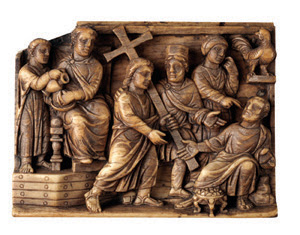
Several reasons for this are put forward in the exhibit's explanatory notes. I got a cramp scribbling them all down and then found out they have a book about the whole exhibit by guest curator Jeffrey Spier.
What the early Christian artists needed and didn't have was a rich patron. Art generally needs a sugar daddy to supply materials and support, Spier explains. Durable artworks couldn't be commissioned until Christianity was strong enough to include wealthier members who would pay for items that could be decorated with biblical images.
Next, there was a little thing called idolatry. The Jewish scriptures have a severe prohibition against idolatry, expanded by the Rabbis to include any artwork that might lead one's mind in that direction. This was strongest in Judea. It was only after Christianity had separated from its Jewish roots that those prohibitions were loosened or reinterpreted. At least that's the theory. Other experts insist that Jews were decorating their synagogues with murals and mosaics containing all manner of human and animal figures. But those examples were from outside of Judea, or after the first century, or both.
Another possible reason for the gap? The apocalyptic dimension of the kingdom Christians were proclaiming meant that this world-- including its artwork, architecture and social institutions--was slated for a drastic and fiery makeover.
Clement of Alexandria (150-215 A.D.) gives us the first documented mention of Christian art:
“And let our seals by either a dove, or a fish, or a ship running with a fair wind, or musical lyre, which Polycrates used, or a ship’s anchor, which Seleucus had engraved; and if the seal is a fisherman, it will recall the apostle, and the children drawn out of the water. For we are not to depict the faces of idols, we who are prohibited from attaching ourselves to them, nor a sword, nor a bow, since we follow peace, nor drinking cups, since we are temperate. Many of the licentious have their homosexual lovers engraved, or prostitutes, as if they wished to make it impossible ever to forget their erotic passions, by being continually reminded of their licentiousness.”
So, Christian porn was off limits! Clement apparently was not advocating creating new symbols, but explaining how to choose from among the many symbols already widely in use for Roman document seals, so that Christians could engage in business without endorsing pagan ideas. This passage is really about re-interpreting pagan symbols. A fish was a fish to a Roman. To a Christian it reflected the Greek acrostic ichthys, "Jesus Christ Son of God."
The earliest works in the Kimbell's exhibit are reproductions, because they couldn't ship the ancient sites to Fort Worth. They're 18th century watercolor copies of catacomb paintings decorating the secret underground places where Christians gathered to worship and bury their dead--for instance, the Catacombs of Domitilla and of Peter & Marcellinus in Rome, around 350 A.D. And they are mesmerizing.
The unnamed original artists don't rank with Michaelangelo. But considering the persecutions that led them to meet in hiding, these paintings--even secondhand-- exhibit a raw energy simply from the fact they were created at all.
The most eye-opening aspect of the exhibit is the subject matter: Jesus is depicted many times as a short-haired, beardless Good Shepherd with a lamb slung over his back. We expect the accompanying fish symbol and the dove, but an anchor? What's with that? Old Testament images dominate, but they're not always the stories we'd choose today. Jonah, for instance, is depicted all through the exhibit's works, not just being swallowed by the big fish, but relaxing under the gourd.
Why? Perhaps because the book of Jonah was one of the readings for the Jewish Feast of Yom Kippur, and Jesus himself made the connection between his death and resurrection and Jonah's three days in the belly of a whale.
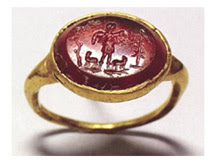
The Good Shepherd image, surprisingly, was not biblical. It was taken directly from a traditional and popular pagan image reproduced throughout the Empire. The ring from the late third century (shown above) is deciphered as Christian only because of the dove in the tree and the initials I H C X, an abbreviation for Jesus Christ.
As Spier explains it,
“Christian artists were able to appropriate this figure and invest it with purely Christian significance. Jesus explicitly stated: ‘I am the good shepherd. The good shepherd lays down his life for the sheep’ (John 10:11), and this passage was surely uppermost in the minds of Christians of the third and fourth centuries when they employed the image on their seal rings, gold glass cups, baptisteries, and tombs."Christians have been appropriating pagan cultural symbols, celebrations and architecture ever since, for good or ill. Some catacombs even have figures of Orpheus mixed in with biblical images. In fact, co-opting what's popular in secular society has today almost supplanted originality in every aspect of Christian media, but that's another story.
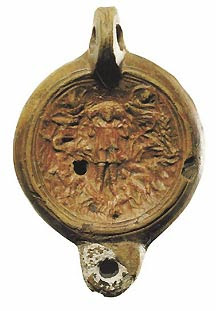
The earliest datable instance of the Good Shepherd motif may be the clay lamp (shown above) from the Florentius workshop made in the early third century. It also depicts Noah’s ark and assorted animals. A stamp on the underside identifies the workshop as Florentius, in or near Rome, which produced many lamps with pagan symbols, Spier says. Apparently much of Christian art, once it got rolling, may not have been produced by Christian hands at all. It might have been merely commissioned from a pagan artisan by a Christian, who requested the particular symbols and decorations. So, is it still Christian art? At some point, people stopped caring.
After all, if Kris Kristofferson can sing Jesus was a Capricorn, definitions are out the window.
The exhibit runs through the end of March.
Next time: What happened when Christianity became legal, then dominant, and finally produced the holy relic only Paul and Jan Crouch could love?
• Furl • StumbleUpon • Technorati Tags: Kimbell Earliest Christian Art, Christian humor, satire, humor
Wednesday, January 9, 2008
Do not go gentle into that World of Warcraft
A member of our Christian fellowship used to be heavily into Dungeons and Dragons. Our Bible study teacher challenged him to interject Jesus into the game and see how long He survived by turning the other cheek. Our friend got the point: we don't expect to "win" in this world. We love in spite of the expectation of suffering, persecution and possible death.
Now someone's had a similar idea. They're putting their character Noor the Pacifist into the universe of World of Warcraft.
A college student is attempting to level two "pacifist" characters up to the top of World of Warcraft's character progression, characters he's playing without attacking anything. It's partly to try out the philosophy of pacifism in the violent virtual world, and partly to see if he can do it.We wish him luck. But I'd put my money on a poison-trained rogue-class Gladiator Draenei with mind-flaying skills instead.
In the words of Mark Twain: "Peace by persuasion has a pleasant sound, but I think we should not be able to work it. We should have to tame the human race first, and history seems to show that that cannot be done."
Virtual history is even clearer on the subject.
(via BoingBoing)
• Furl • StumbleUpon • Technorati Tags: Noor World Of Warcraft, Christian humor, satire, humor
There will be stupidity
My fellow blogger at The Door, John Bloom, tells about a Mother Jones article on groups that are prospecting for oil using scriptural "clues."
That reminded me I had some info on the subject that I never posted (so much malarkey, so little time):
Zion Oil & Gas, the company that's exploring for oil in Israel based on a scriptural promise, is in the news again.
The company's directors believe Deuteronomy 33:24 points to rich oil deposits.
Moses said, “Let Asher be blessed with children … and let him dip his foot in oil.” The tribe of Asher was located in a geographic location shaped like a foot and that the passage referenced to the northern region of the tribe of Manasseh. Also, Genesis 49:22-26 mentions “a well,” and “blessings of the deep that crouch beneath” that “shall be on the head of Joseph.” "Blessing of the deep” could be a reference to oil, and “the head of Joseph” refers to the head-like boundary of ancient Manasseh.Got that? Many scholars would say "oil" refers to olive oil. But no matter.
What I found interesting was a disclaimer at the end of their most recent press release, which is so air tight I'm going to suggest we use it on everything we publish here at The Wittenburg Door.
Maybe it's just standard jargon, but it doesn't inspire confidence, and I don't really understand it. Do you?
FORWARD-LOOKING STATEMENTS: Statements in this press release that are not historical fact, including statements regarding the Zion's future operations, their timing, the potential results thereof and plans contingent thereon, are forward-looking statements as defined in the "Safe Harbor" provisions of the Private Securities Litigation Reform Act of 1995. These forward-looking statements are based on assumptions that are subject to significant known and unknown risks, uncertainties and other unpredictable factors, many of which are described in Zion's periodic reports filed with the SEC and are beyond Zion's actual performance to differ materially from the results predicted by these forward-looking statements. Zion can give no assurance that the expectations reflected in these statements will prove to be correct and assumes no responsibility to update these statements.If that's not oily, I don't know what is.
• Furl • StumbleUpon • Technorati Tags: Zion Oil And Gas, Christian humor, satire, humor
Monday, January 7, 2008
'Taters reveal cruciform image!
A Houston woman and her husband have discovered what she says appears to be the image of a crucifix in a potato.
Well hush my puppies and call me crucifried.
Dawn Roth-Ehlinger and her husband were grilling hamburgers and frying potatoes for friends during a backyard cookout, when they noticed something odd while preparing the French fries.
As Dawn's husband sliced a potato, he says he saw a pattern reveal itself which appeared to be images of Christ and the crucifix in three different sections.
Ms. Roth-Ehlinger told a TV reporter they didn't eat the potato slices but disposed of them in her sink. "The disposal works great now," she added.
I don't know about you, but this kind of thing leaves me completely bespuddled. The miracle is, had they been making curly fries, the image would have remained unseen.
• Furl • StumbleUpon • Technorati Tags: Crucifix In A Spud, Christian humor, satire, humor
Friday, January 4, 2008
Resolutions of the Televangelists 2008
In case you missed this on the www.wittenburgdoor.com website, the televangelists are straining to exercise some willpower this year: • Pat Robertson: I will not make delusional predictions for the coming year unless at least one of my previous predictions at least partially came true. I will repeat this resolution to myself three times a day so I don't forget it.
• Joel Osteen: I resolve to frown at least 15 minutes each day so my smile will look genuine the rest of the time. But I will do it hanging upside down in my gravity boots so that the frown looks like a smile.
• Kenneth Copeland: This year I will speak into existence a world in which Sen. Grassley is a teensy-weensy bumblebee bat, one of the world's most endangered species. Then I will suck him into the engines of my $20 million Cessna Citation as I fly off to the Fiji islands.
• Benny Hinn: Whenever Jesus Christ appears to me visibly onstage, or when I hear his voice audibly as if he were standing right beside me, I will pinch myself, and then have one of my aides pinch me too. Then I will have another aide pinch that aide. And so on.
• Joyce Meyer: I will upgrade my $23,000 commode with a bidet, but switch to a lower grade of toilet paper. And each time I lambaste the concept of separation of church and state as being unconstitutional and "a deception from Satan," I will re-read the Constitution and place a call to the Evil One, just to check my facts.
• Creflo Dollar: I will repeat five times a day, "The decreasing value of U.S. currency this year does not reflect on my personal self-esteem." But I'll still keep tryin' to change my name to Creflo Krugerrand.
• Jan and Paul Crouch: We resolve to simplify our lifestyles away from reflecting the glittering Versailles of the "Sun King" Louis XVI to the more ecologically sensitive regal ostentation of Restoration England under Charles II. We will call this "going green."
• Hal Lindsey: I resolve to be even more confrontational about radical Islam in order to obscure the failure of my 37 years of end-time predictions and remind people that I still exist. Darn, I miss the Soviet Union!
• Rod Parsley: If I ever say "Man your battle stations! Ready your weapons! Lock and load--for the thirty, forty liberal pastors who filed against our ministry with the Internal Revenue Service" again, just shoot me.
• Randy and Paula White: We resolve to remember to pay for private jets we say we're going to purchase, instead of coughing up $112,000 in damages for cancelling the deal. And we resolve to place in our bio only those doctorates we actually earned, and to claim only doctorates at schools that actually exist. Oh, and we resolve to make sure there are no pesky lawyers around when we scam an old lady out of her life savings. Amen.
• Bishop Earl Paulk: I will fast from sex scandals the entire year. Instead I will promote my dominionist theology and the belief that Jesus will not return until the whole world has heard about me.
• Richard Roberts: I resolve to cancel my wife's cell phone contract, skip the annual home remodeling at university expense, return her red Mercedes convertible and white Lexus SUV, and see about the possibility of shredding the document-shredding machine. Oh yeah, and find a way to unplug the Unblinking Eye of Sauron from the ORU Prayer Tower and take it with me.
• John Hagee: I resolve to squeeze my corpulent, jiggling torso into a barrel and roll from San Antonio to the Holy Land to support the State of Israel. Who will join me?
• Furl • StumbleUpon • Technorati Tags: Televangelists Resolutions, Christian humor, satire, humor
Wednesday, January 2, 2008
The Year in Religion 2007
In case you missed this on the www.wittenburgdoor.com site, here's our rundown of the Year in Religion:
• Mother Teresa: Come Be My Light, a collection of the humanitarian's previously unpublished letters, revealed her to be a big ol' whiner.
• Evangelicals, embarrassed by their previous environmental insensitivity before recently becoming "green," turned a bright orange in 2007.
• First, Trinity Broadcasting Network became the new owner of the Holy Land Experience, a biblical theme park in Orlando, Fla. Then, the Creation Museum opened in Petersburg, Ky. Finally, faced with a "failure to communicate" from several televangelists, Sen. Charles Grassley made plans to open the Elmer Gantry Religious Work Camp based on the set from Cool Hand Luke. I bet you can't eat 50 eggs, Benny.
• The family of a woman who died from a snakebite during a religious service last year sued the Kentucky hospital that treated her because of disparaging remarks about her beliefs. Wait... she wasn't actually handling those serpents, was she? 'Cause that's crazy.
• Sixty-eight percent of Republicans polled said they doubt humans evolved from lower life forms over millions of years, although they find it easy to believe Democrats did.
• Twenty-five percent of Americans believed it was at least somewhat likely Jesus Christ would return in 2007, according to an Associated Press poll. They were wrong.

•International Fishing Ministries Association in British Columbia sponsors fishing excursions in place of worship services because, founder Ed Trainer says, “Church is too boring for men. Church is set up like a country club for women.”
• Southwestern Baptist Theological Seminary added a homemaking class to its curriculum, which was criticized as an “absurd aberration.” But now the ladies have a lucrative deal to fry up the International Fishing Ministries' catch of the day. So who's absurd now?
• The film The Lost Tomb of Jesus presented evidence producers say could prove Jesus was married to Mary Magdalene and had a son. No evidence was presented that showed the Holy Family needed a homemaking class.
• The Vatican denied concealing the Fourth Secret of Fatima, which some claim contains the full truth about the end of the world. (Our guess: The apocalypse will not be preceded by a series of speculative books on eschatology involving secret "codes" and long-buried mysteries).
• The Church of Jesus Christ of Latter-day Saints mounted a PR campaign to better explain what it means to be Mormon. While trying to deny they believe Jesus and Lucifer were brothers, they, uh, inadvertently admitted they did believe that.
• Spiritual website Beliefnet.com was bought by Rupert Murdoch. He promptly renamed it newscorpdirecmoneynet.com.
• Amway distributors lost a $19 million suit for spreading rumors about satanism at the Procter and Gamble Co. But we're still creeped out by that spooky P&G crescent-moon logo thingee.
• Theologians redoubled efforts to interpret the meaning of "Bong Hits 4 Jesus."
• The National Primitive Baptist Convention marked its centenniel by singing a capella, starting fires with flint shards and bringing down a wildebeest with a simple throwing stick.
• The Jordan River, revered by Jews, Christians and Muslims, was found to be so polluted that the World Monuments Fund designated it an “Endangered Cultural Heritage Site.” Rupert Murdoch then offered to buy it, clean it up and change its name to The NewscorpFoxDow Stream of Revenue Channel.
• A Barna survey found that America's ungrateful, complaining young people see Christians as being judgmental.

• A new animated version of The Ten Commandments featured a more compassionate Moses with the voice of Christian Slater, who turned out to be surprisingly skilled at rebuking graven images.
• Unitarians tried to raise their profile with a $425,000 ad campaign. Their slogan was “Find us, and ye shall seek.” Really.
• In Jezebel: The Untold Story of the Bible’s Harlot Queen, author Lesley Hazleton claimed Jezebel got a bad rap. Well, at least we know one thing about her-- she failed as the Dog Whisperer.
• Discount chain Wal-Mart test-marketed biblical action figures... and then hired them with no health benefits.
• Tony Blair converted to Catholicism in December. He's now known as the Pope's "poodle."
• Furl • StumbleUpon • Technorati Tags: Year In Religion 2007, Christian humor, satire, humor
Thursday, December 27, 2007
Punch drunk love in Bethlehem
I had a premonition of this a few days ago when I noticed CNN had mislabeled Bethlehem's Manger Square as Manger "Scare." Hmm.
In a microcosm of everything that's gone wrong in the history of the Christian church, two sects came to blows at the Church of the Nativity in Bethlehem today.
It seems the Greek Orthodox and Armenian Apostolic priests were cleaning the church in preparation for the Eastern rite observance of the birth of the Prince of Peace the first week in January.
The dispute started when the Greek Orthodox contingent wanted to place a ladder over the Armenian portion. (I know that always ticks me off). Four people were wounded in the fray.
This is a mere shoving match compared to the annual brawls over at the Church of the Holy Sepulchre in Jerusalem. In 2004, Greek and Russian Orthodox believers took offence at a door left open by members of the Franciscan order during a service. Five were injured then.
In 2002, monks from the Ethiopian Orthodox Church and the Coptic Church of Egypt--two groups which for years have been vying for control of the Jerusalem church's roof --fought over the position of a chair on the roof.
According to the BBC article, to prevent squabbling, two Muslim families have had guardianship of the key to the only entrance to the Church of the Holy Sepulchre since 1178, when they were entrusted with it by the Muslim ruler Saladin.
• Furl • StumbleUpon • Technorati Tags: Bethlehem Church of the Nativity, Christian humor, satire, humor
Wednesday, December 26, 2007
Casualty in the war on Christmas?
South Church Unitarian Universalist Church in Portsmouth, N. H., had to give up its Christmas trees when someone turned in the church for apparently violating the fire code, which prohibits trees at all places of assembly.
The congregation got as riled up as it's possible for Unitarians to be.
They decided on a ceremony to “reflect on the symbolism of the trees, thank them for gracing our sanctuary for the brief time they were up, and say good-bye to them in ritual.”
There was no report on how the trees felt about that.
• Furl • StumbleUpon • Technorati Tags: Unitarian Christmas Trees, Christian humor, satire, humor
Tuesday, December 25, 2007
Oy to the World!
Composer, arranger, and non-stop serial music maker Paul Libman has scored thousands of commercials and composed for the musical theater. He wrote the annoying theme song for Jim Nayder's NPR mainstay, The Annoying Music Show.
Now he's created ex nihilo a band called The Klezmonauts to merge Christmas music and the Klezmer sound of Jewish tradition in an album of Klezmer Carols.
The album contains 10 songs —nine "traditional" tunes and one original work called Santa, Gey Gesunder Heit (Go in Good Health).
Listen to The Klezmonauts' version of Jingle Bells.
And here are more samples from the album.
• Furl • StumbleUpon • Technorati Tags: he Klezmonauts, Christian humor, satire, humor
Friday, December 21, 2007
Oy Vey in a Manger

Here's our vote for worst holiday event. A creepy, demented evening of fun with The Kinsey Sicks.
The Kinsey Sicks take their Sickrilegious songs to the left coast. The show includes such wholesome favorites as, "God Bless Ye Femmy Lesbians," "A Lay in a Manger," "Soylent Night," as well as "I Had a Little Facial" to the tune of "I Had a Little Dreidel," "Jews Better Watch Out," "Macaroona" and "Papirossen."
Remaining dates: Fri., Dec. 21: Seattle: Triple Door, 216 Union Street.
Sat., December 22: San Francisco: Herbst Theatre, 401 Van Ness Avenue.
You can even order The Kinsey's first DVD, The Kinsey Sicks: I Wanna Be a Republican as a stocking stuffer.
Thanks to Jewcy.com for alerting us.
Monday, December 17, 2007
Get Ready for Darden and the 'Spirit Wail'
Wittenburg Door Senior Editor Robert Darden is scheduled to be on NPR's Fresh Air with Terri Gross Tuesday, Dec. 18 THURSDAY Dec. 20 (times will vary in individual markets). 
We assume she'll ask him about his book People Get Ready! A New History of Black Gospel Music. We assume she won't ask him about his tenure as editor of The World's Pretty Much Only Religious Satire Magazine. But we can still dream.
Bob was super excited when he told us about all this: "We're taping tomorrow morning. I've pulled 10-15 of my favorite 'lost' songs from the Black Gospel Music Restoration Project, including an eerie 20-second "spirit wail" from Little Richard, to play and discuss!"
Darden is a former gospel music editor for Billboard magazine and is currently on the journalism faculty at Baylor University. And he plays the drums. Tune in! Listen to the podcast!
• Furl • StumbleUpon • Technorati Tags: Robert Darden On Fresh Air, Christian humor, satire, humor
Wednesday, December 12, 2007
Apokalipecac

With CNN reporting shocking stories of female students posting falling-down-drunk photos of themselves on Facebook, it may come as a surprise to find similar practices among the ancient Mayans, but for different reasons. I think.
Archaeologists discovered an intricately carved 1,400-year-old "death vase" along with parts of a human skeleton while excavating a small Mayan "palace" in northwestern Honduras.
The vase offers a window onto rituals of ancestor worship that included food offerings, chocolate enemas, and hallucinations induced by vomiting, experts say.
"The way to have contact, to communicate, with ancestors is to have visions," said Christian Wells, an anthropologist at the University of South Florida
"And you have a vision either by cutting yourself and bloodletting—which there's really no evidence for in this case—or by having some very powerful chocolate enema, or by drinking your brains out and throwing up."
"We think this beverage [in the vase] may have contained ipecac, which would have made the person who's drinking it throw up—a lot. Then, by throwing up a lot, they could've had visions that would have allowed them to talk with the ancestors."
OK. In college, whenever I drank my brains out until vomiting, I often talked with God. And several times with the police.
But it's the chocolate enema that caught my attention. No doubt a photo of that will appear on Facebook soon, too. Can't wait.
Of course we need to keep our perspective here. Wasn't it an old Mayan parable that said, "The enema of my enema is my friend?"
• Furl • StumbleUpon • Technorati Tags: Mayan Death Vase, Christian humor, satire, humor
Sunday, December 9, 2007
Cheeses, Christ and politics

Tired of hearing about the Evangelical voting block? Wish the Religious Right and Mitt Romney would just go away? Got a Mike Huckabee overload?
If churches really want to influence government, they should forget about registering voters and pushing candidates, return to simpler times and follow the lead of John Leland.
This eccentric Baptist preacher and champion of separation of church and state was so pleased when Thomas Jefferson was elected president that he persuaded the ladies of his Baptist congregation in Cheshire, Mass., to manufacture an enormous cheese as a gift. He intended to present it to President Jefferson in honor of his republicanism and his support of religious liberty.
The motto "Rebellion to tyrants is obedience to God" was engraved into the rind. This was a smart public relations move in 1801.
The completed cheese wheel was enormous--4 feet 4 1/2 inches in diameter, 15 inches thick and weighing 1,235 pounds. It required the milk of 900 cows. Jefferson's Federalist opponents thought the display was ludicrous and ridiculed the gift in the press.
As reflected in a poem inspired by the occasion, Leland offered a prayer:
"Elder J. with lifted eyes
In musing posture stood,
Invoked a blessing from the skies
To save from vermin, mites and flies,
And keep the bounty good."
(From The Complete Book of Cheese, by Robert Carlton Brown)
 (Apparently leaders like to eat cheese. This started a tradition. Andrew Jackson and his fellow party guests finished off a similarly sized cheese in two hours. Martin Van Buren got a giant cheese, too. Queen Victoria received a 1,400-pound cheese as a bridal gift.)
Jefferson, for ethical reasons, insisted on paying $200 for the cheese when it arrived Dec. 29, 1801. He thanked Leland and the ladies for their "token to the great cause of equal rights to all men" and a proof of their "domestic arts, which contribute so much to our daily comfort."
The domestic arts! If that other Baptist— Paige Patterson— is looking for vindication for his new cadre of Baptist Homemakers at Southwestern Baptist Theological Seminary, this could be it. A project like this could consume several semesters, and greatly advance the .... well, it would be tasty, anyway.
(Some of this via Metafilter)
• Furl • StumbleUpon • Technorati Tags: John Leland Mammoth Cheese, Christian humor, satire, humor

